
Blog & nowości
Camera Filters: Light, Control, Style
Contemporary digital cameras offer an impressive dynamic range and high sensitivity, yet it is the control of light before the sensor that largely determines the final character of the image. Camera filters are not merely corrective tools — in cinematographic practice, they represent a deliberate aesthetic and technical choice.
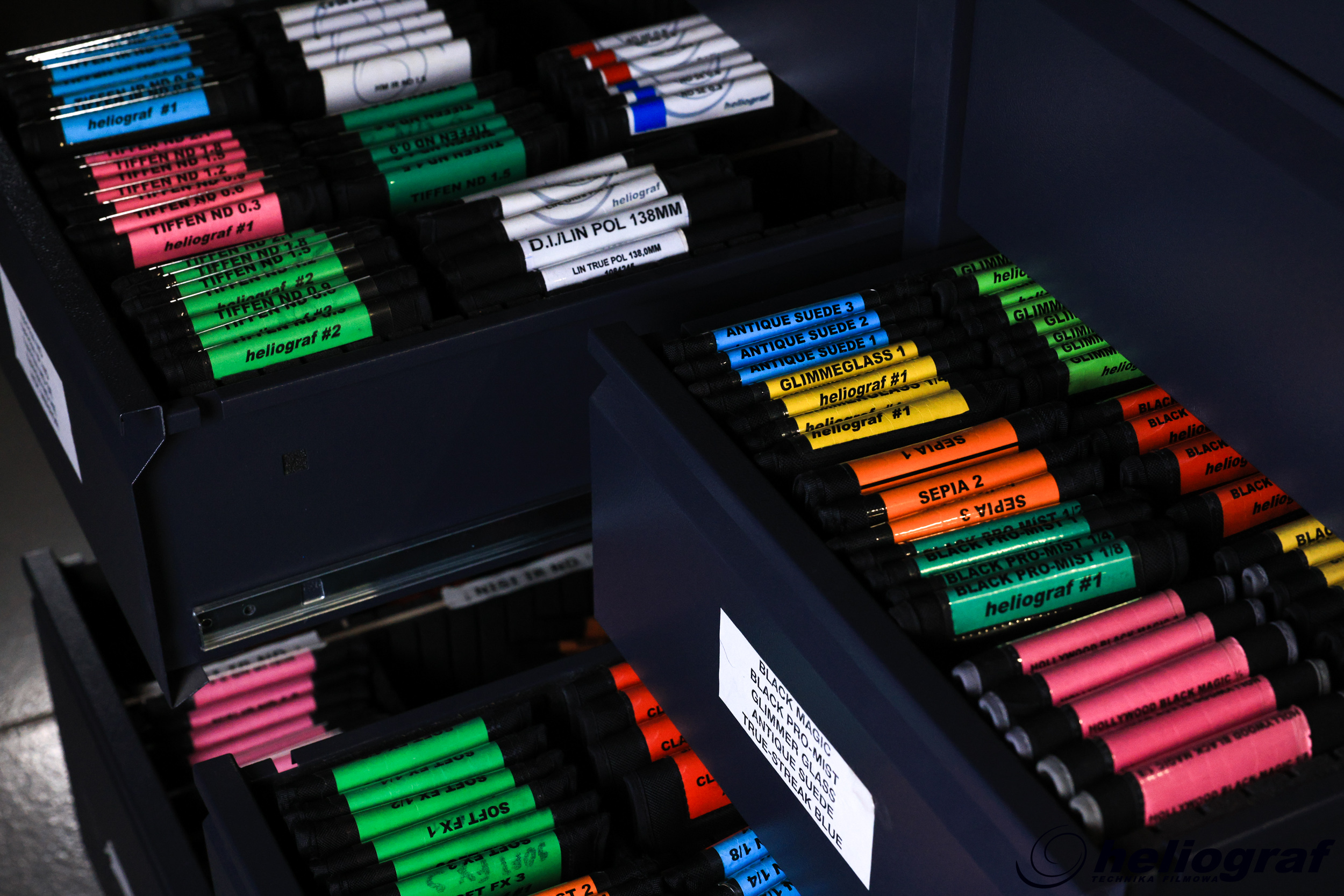
A carefully selected set of filters allows precise control over exposure, contrast, light spectrum, and highlight rendition directly at the shooting stage. Differences between ND, full spectrum, polarizing, or diffusion filters translate into material consistency and predictability during post-production.
Below is a technical overview of the filter sets available at Heliograf, categorized by functional groups with notes on their on-set applications.
ND FILTERS (Neutral Density)
ND filters reduce the amount of light reaching the sensor without altering color balance (under ideal conditions). They enable:
•Maintaining a constant aperture (e.g., T2.0 in bright sunlight),
•Controlling depth of field,
•Preserving a 180° shutter angle at high exposures,
•Managing highlight roll-off in cameras with high base sensitivity.
The ND value (0.3 / 0.6 / 0.9, etc.) corresponds to a reduction of 1 / 2 / 3 EV stops.
IRND Filter Sets:
•4×5.65 – NiSi IR ND (0.3–3.0)
•4×5.65 – Tiffen IR ND (0.3–2.1)
•4×5.65 – Tiffen IR ND Hot Mirror (4 mm)
ND Filter Sets:
•4×5.65 – Tiffen ND (0.3–2.1)
•4×5.65 – ARRI FSND (0.3 + 2.4)
Graduated / Half ND Filter Sets:
•NiSi IR ND Grad – Soft / Hard (0.3–1.2)
•Tiffen ND Grad – Soft / Hard (0.3–0.9)
ND filters are also available in 6×6:
•Tiffen ND (0.3–2.1)
•Tiffen ND Grad Soft / Hard (0.3–0.9)
Variable ND Filters:
•4×5.65 – NiSi Variable ND (0.6–1.8)
•4×5.65 – Lindsey Optics Variable ND (0.6–2.4)
Based on a dual polarizer (cross-polarization) design, allowing smooth adjustment without swapping glass.
Applications:
•Dynamic lighting conditions,
•Run-and-gun shooting,
•Steadicam, gimbal setups.
Special ND Filters:
•114 mm – NiSi Enhance ND-Vario (1.5–5 stops) – screw-in, for lenses without a matte box
•4×5.65 – NiSi Yellow Light Blocker – reduces yellow light dominance (LED / sodium vapor), used in mixed urban lighting
POLARIZING FILTERS
Eliminate non-metallic reflections and enhance color saturation by selectively reducing polarized light.
Light reduction: approx. 1.5–2 stops.
NiSi:
•4×5.65 – NiSi Enhance CPL
•4×5.65 – NiSi Linear Polarizer
•138 mm – NiSi Polarizer
Schneider:
•Circ True-Polar
•Lin. True-Polar 138mm
•Circ. Polar Unmounted 138mm
Tiffen:
•Ultra Circular Polar
•Linear Polar 138mm
•WTR/WHT Ultra Circular
4×4 Format: Filter Polarizer
6×6 Polarizing filters:
•Tiffen Polariser / Ultra Circ
CLEAR (PROTECTIVE) FILTERS
Do not affect exposure or color. Protect against:
•Scratches and impacts,
•Dust,
•Pyrotechnic effects,
•Splashes and liquids.
In commercials and VFX-heavy shoots, a protective clear filter is essential for lens safety.
Sets:
•NiSi Pure Clear
•NiSi Clear Explosion-Proof
•Tiffen Clear Premium Coated
•Format Filter Clear
6×6 Clear filters:
•Tiffen Clear
•NiSi Pure Clear
Effect filters 6×6 (typically for large zoom and wide-angle lenses):
•Schneider Classic Soft
•Schneider Hollywood Black Magic
•Tiffen Glimmer Glass
The correct selection of ND, polarizing, or diffusion filters directly affects:
•Dynamic range,
•Image rendition and texture,
•Highlight character,
•Color quality prior to post-production.
When treated as an optical tool, a well-chosen filter set shapes the visual language of a production.
If you require a cinematographer’s consultation for selecting filters for a specific project, Heliograf’s camera department offers technical support during pre-production.


